Data-driven HR was supposed to revolutionize the workplace, but the reality hasn’t matched the hype.
For years, experts promised that people analytics would transform HR into a strategic powerhouse. Yet few companies have seen meaningful payoff. Surveys show interest is high – 71% of firms consider people analytics a top priority (reflektive)– but impact is low.
One recent report found 65% of organizations saw no commercial benefit from their HR analytics initiatives (multibriefs). The vision of HR leading decisions with dashboards and algorithms remains largely unfulfilled, casting doubt on the “data-driven HR future.”
🚧 Why the Data-Driven Future Stalled
Several roadblocks have kept people analytics from delivering value:
- Data chaos: HR information is scattered across multiple systems. Many organizations collect plenty of data but only a handful of them have useful, quality data for HR analytics. Without clean, consolidated data, even the best analytics tools struggle.
- Skills & culture gap: Successful analytics needs both tech talent and a data-driven mindset. These are often lacking. HR teams may not have enough analysts, and executives often default to intuition. In fact, 4 in 5 HR professionals say their leaders still rely on gut feelings when making people decisions (Oracle).
- Overpromised tools: The HR tech market flooded with “magic” analytics solutions, but many overpromise. A blunt analysis noted that HR analytics products often “fail to provide the tools for HR to capture the strategic value” of data. Simply buying a fancy dashboard won’t create impact if it’s not aligned to real business needs. As Josh Bersin observes,
Companies spent billions on HR systems yet fewer than 10% can connect people data to business outcomes (joshbersin.com).
Many initiatives remain stuck in HR silos, producing interesting charts but no actionable intelligence
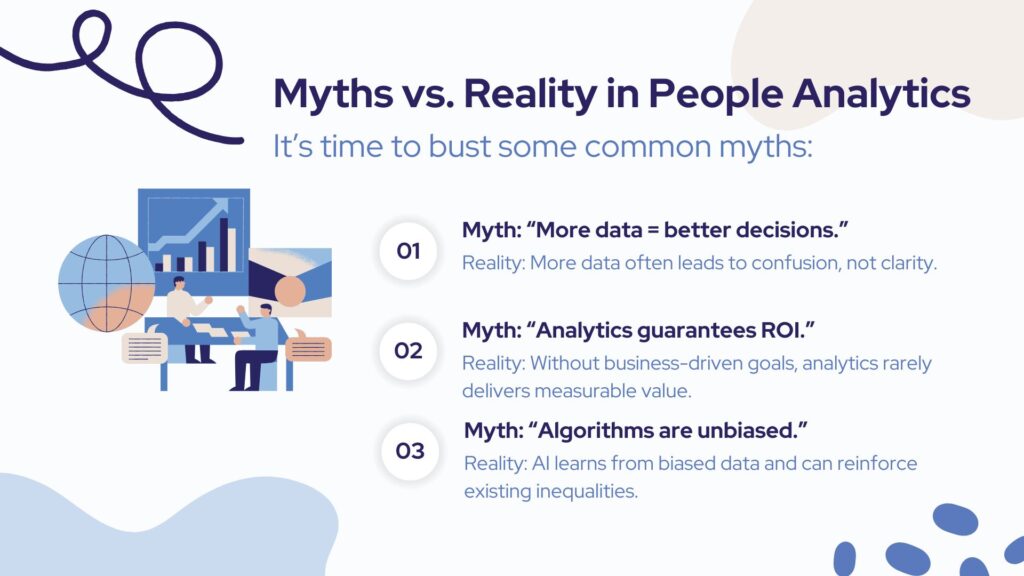
💡 Myths vs. Reality in People Analytics: It’s time to bust some common myths
- Myth: “More data = better decisions.”
Reality: Organizations drowning in HR data often can’t derive actionable insight. Without context, big data can lead to big confusion. Better a few relevant metrics than hundreds of reports no one acts on. - Myth: “Analytics guarantees ROI.”
Reality: Tools don’t automatically deliver value. People do. Without clear business-driven goals (like reducing turnover or improving sales performance), an analytics project easily becomes a science experiment. - Myth: “Algorithms are unbiased.”
Reality: Data reflects human biases. If historical promotion data skews toward certain groups, a predictive model will simply perpetuate those biases (hr-focus.com). Blindly trusting “objective” algorithms can backfire, reinforcing the very issues HR aims to fix.
📊 The Elusive ROI of People Analytics
The fundamental problem is the lack of demonstrated ROI.
HR analytics efforts often focus on HR metrics (turnover rates, engagement scores) without translating them into business KPIs like profit, productivity or customer satisfaction.
CEOs have grown impatient for results. Despite isolated successes, there’s a dearth of case studies showing major bottom-line gains from people analytics.
Yet the promise isn’t a total mirage. Research indicates that organizations with a strong analytics culture do outperform their peers – for example, they are far more likely to report above-average financial performance (cipd.org).
The catch: only a minority of firms have reached this level of analytics maturity.
💼 Getting to Business Value: From Myth to Reality
To move past the myth and realize the business value of People analytics, companies need a strategy reboot:
- Start with specific problems:
Rather than “boiling the ocean” with big data, successful teams zero in on concrete business challenges (e.g. high sales turnover, a spike in absenteeism). By targeting an urgent issue, analytics efforts stay relevant and outcome-focused. - Ensure executive buy-in via quick wins:
Demonstrate value early by tying analytics to outcomes leaders care about. Leadership support grows when they see metrics that matter (like revenue per employee or customer ratings) improve thanks to data-driven changes. - Invest in data and skills:
Without clean data and the talent to analyze it, analytics will disappoint. Companies succeeding in people analytics put serious effort into unifying data sources and upskilling HR in data literacy. - Speak the business language:
Frame HR analytics in terms of business outcomes. Don’t just report an “engagement score up 5%”, translate it: “likely saved $X in attrition costs” or “improved customer satisfaction by Y%.” When people analytics links to the business scoreboard, it stops being an HR experiment and becomes a strategic tool.
🔮 Conclusion: No More “Myth,” More Method
The past years proved that technology alone can’t fix HR’s challenges. To deliver on the promise, people analytics must be business-driven at its core. That means focusing on high-value use cases, building trust in data, and measuring success in business terms.
HR leaders who get this balance right are turning the myth into reality: using data not for its own sake, but to make better decisions that drive business results. In the end, that’s what data-driven HR is supposed to be about 🚀
📩 Want to stay ahead of the curve?
If you found this useful, subscribe to my People Analytics Insider newsletter for:
- Exclusive case studies (like the bias audit we did for a Fortune 500 company)
- Templates (data governance checklist, HR metrics guide)
- Deep dives on turning analytics into action
🚀 Ready to upgrade your people analytics in your firm? Let’s check out the HR metrics you should be tracking