Companies are shifting from rigid jobs to agile skills to stay competitive in a fast-changing world.
🔥 Aside from AI, skills-based organizations (SBO) are the hottest topic everyone’s talking about. But if this approach is so promising, why are so many leaders hesitant to even start the transformation? Below I will explain why the skills-based approach is trending, why it’s hard to implement, and how to break through to build a true skills-based organization.
What is a Skills-Based Organization (SBO)? 🤔
Instead of confining people to static job descriptions, an SBO views each employee as having a unique portfolio of skills, capabilities, and potential contributions beyond any one role.
Work is organized more flexibly (think project-based, cross-functional, or gig-like assignments) so that talent can flow to where their skills create the most value at any given time.
Why It’s Trending 🚀
Here are five big reasons everyone’s paying attention to the skills-based model:
- 🚀 Business Agility Requires Talent Fluidity: In today’s volatile markets, companies need to pivot quickly. A skills-based workforce where people continuously learn and redeploy their skills as needed, organizations can maximize flexibility and respond faster to change by moving talents to across projects or priorities (rather than being stuck in rigid departments).
- ⚠️ Talent Shortages Demand Skills-First Strategies: With skill gaps and labor shortages, organizations are broadening their search and hiring for skills over credentials. In fact, 73% of business executives expect ongoing talent shortages and are sourcing candidates based on skills rather than just prior experience (Deloitte). Dropping old requirements (like college degrees) widens talent pools and helps companies fill critical roles.
- 🌱 Workers Demand Growth and Autonomy: Today’s employees aren’t just looking for a job, they want opportunities to grow their skills and shape their careers. Studies show that over half of workers are more likely to join or stay at a company that gives them more agency in how they apply and develop their skills. A skills-based approach appeals to these desires by treating workers as dynamic individuals with evolving skill sets, rather than cogs in a static job.
- 🤖 Tech Disruption Forces Constant Reskilling: The rise of automation and AI is radically changing the skills needed in the workforce. According to the World Economic Forum’s Future of Jobs Report 2025, around 39% of workers’ core skills will be disrupted or outdated by 2030. The half-life of many technical skills is now less than 5 years in fast-moving fields (BCG). Embracing a skills-based organization where learning is ongoing, is a way to future-proof the workforce against technological disruption.
- 💼 Traditional Job Structures Are Breaking Down: The very definition of a “job” is becoming less relevant. Work increasingly happens across functional boundaries and project teams, not neatly within one job title. Deloitte found that 71% of workers said they frequently perform tasks outside their formal job description. Rigid corporate hierarchies built on fixed jobs simply don’t fit how work gets done anymore.
Key Challenges 😬
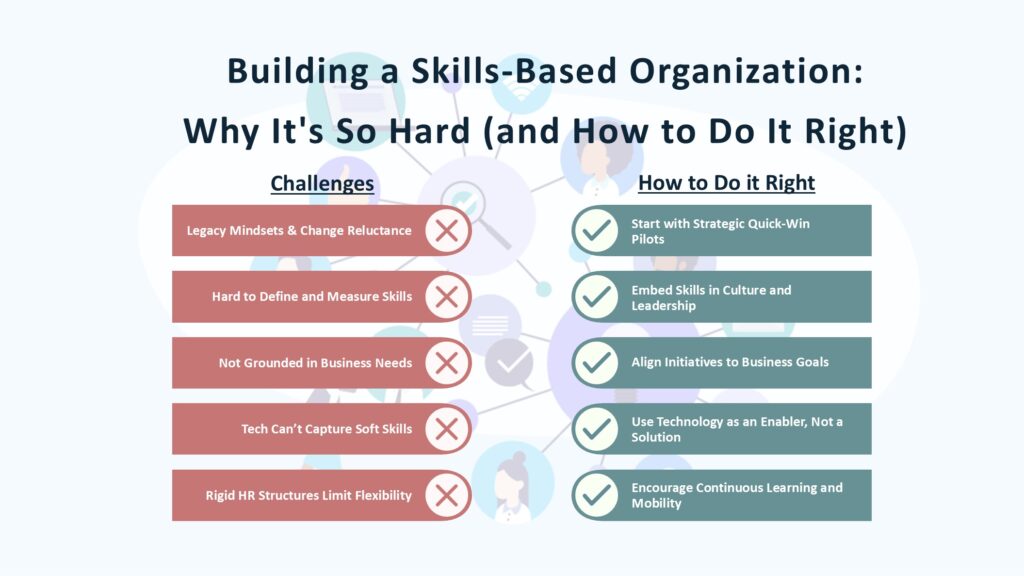
If the benefits are so great, why isn’t every company already a skills-based organization? The reality is this transformation is hard, and many initiatives stall or fall short. Here are five key challenges holding back change:
-
🔒 Legacy Mindsets & Change Reluctance: A century of “people management” based on jobs, titles, and hierarchy doesn’t disappear overnight. Leaders and managers often still think in terms of fixed roles and departments, making it hard to embrace fluid talent practices. Overcoming this cultural inertia requires a massive shift in how people think about careers, performance, and “who does what” at work.
-
📏 Hard to Define and Measure Skills: What exactly is a “skill,” and how do you inventory the skills of an entire workforce? As industry leader Josh Bersin points out, “building a skills taxonomy can be complex” because business skills span many categories and are valued differently by different companies (joshbersin.com). It’s relatively easy to catalogue technical skills, but much harder to quantify soft skills like creativity, learnability, or leadership. Measuring skills is far more complex than posting jobs, and many companies feel stuck at this step.
-
🎯 Not Grounded in Business Needs: Many early efforts have gone nowhere because they were poorly conceived and not tied to strategy. A BCG study noted that some companies launch a flurry of skills-related programs that don’t build on each other or support the broader workforce plan. If a skills-based program doesn’t solve a tangible business problem, it likely won’t last.
-
🤖 Tech Can’t Capture Soft Skills: Many HR tech vendors promise AI that can automatically infer everyone’s skills and magically match people to projects. In reality, algorithms can parse resumes for keywords or analyse work outputs, but they struggle to discern qualities like leadership, adaptability, or teamwork. Technology is a critical enabler (especially for handling big data), but it must be used wisely, and it can’t replace human judgment in understanding people’s true capabilities.
- 🧱 Rigid HR Structures Limit Flexibility: Our existing HR processes often aren’t built for a skills-driven approach.From job architectures and pay scales, to performance management and career paths are typically organized around jobs and titles. Skill-based model will require an overhaul in HR policies, reward systems, and organizational design, which is a complex undertaking that many companies are only beginning to grapple with.
How to Build a Skills-Based Organization 🏗️
It’s a journey that requires both mindset shifts and concrete changes across the company. Here are five strategies to help companies break through and build a successful skills-based organization
- 🏁 Start with Strategic Quick-Win Pilots: Identify a high-impact area to pilot the approach. Focus on a business unit or workforce segment where critical skill gaps exist or agility is urgently needed. By zeroing in on a use case with clear business value, you can achieve quick wins and measurable results (e.g. faster project delivery, improved output per employee). This creates proof of concept and momentum for scaling later.
- 🧭 Align Initiatives to Business Goals: Anchor it firmly to your company’s strategic objectives. Ask: “What pressing business problem will this help solve?” Involving business leaders (not just HR) from day one. When a skills program is embedded in the business with clear metrics, it’s far more likely to get leadership buy-in and deliver tangible value.
- ⚙️ Use Technology as an Enabler, Not a Solution: Modern HR tech (AI skill platforms, talent marketplaces, etc.) can greatly aid a skills-based organization, but let the strategy drive the tech, not vice versa. First define the problems you’re trying to solve, only then explore technology that fits those needs. Leverage data and AI to scale insights about skills.
- 🤝 Embed Skills in Culture and Leadership: Leaders and managers need to champion a mindset that values growth, flexibility, and meritocracy based on skills. Build understanding and buy-in through training and clear communication: for instance, teach managers how to think “skills-first” when assigning work or considering candidates for a role. Recognize and reward managers who cultivate talent mobility on their teams. The goal is to make “skills over jobs” a core part of how your organization thinks and behaves, from the C-suite to the front line.
- 📚 Encourage Continuous Learning and Mobility: A skills-based organization is powered by continuous development and internal mobility, so invest in your people accordingly. Set up robust upskilling and reskilling programs to help employees build the capabilities needed for the future. Support career paths that are non-linear, letting people move to new roles if they have or can learn the skills, rather than waiting for a promotion in the same silo.
Building a skills-based organization is a journey that won’t happen overnight. But the trend is here to stay and those who get it right will gain a more adaptable, future-ready workforce and a competitive edge in the market.
📩 Want to stay ahead of the curve?
If you found this useful, subscribe to my People Analytics Insider newsletter for:
- Exclusive case studies (like the bias audit we did for a Fortune 500 company)
- Templates (data governance checklist, HR metrics guide)
- Deep dives on turning analytics into action
🚀 Ready to upgrade your people analytics in your firm? Let’s check out the HR metrics you should be tracking