Despite being home to some of the world’s fastest-growing economies and most digitized workforces, Asia-Pacific is falling behind when it comes to People Analytics.
According to a Global Human Capital Trends report from Deloitte, 89% of APAC leaders say people analytics is important to their business strategy, yet only 38% believe their organizations are prepared to use it. The intent is there. The action? Not so much.
Most organizations in the region remain stuck at the descriptive stage: using dashboards and reports, but struggling to turn data into decisions. And unlike in North America and Europe, where the adoption curve has steepened, APAC has stalled. This isn’t just a technology gap. It’s a leadership mindset gap.
As an HR leader in Asia, this is our challenge to solve, and our opportunity to lead.
📉 Why APAC Is Behind
Let’s be honest: People Analytics in APAC is often treated as a nice-to-have. A support function. A project that starts strong, then fizzles when funding dries up or business leaders don’t engage.
The Research by Josh Bersin and Visier, as well as Article from Fermin Diez found that:
- 70% of APAC organizations remain at Level 1 or 2 maturity, focused on reporting, operational efficiency, but not predictions.
- Common blockers include: lack of internal capability, fragmented systems, and executive skepticism.
Culturally, the region leans toward hierarchy and intuition. Data may be seen as challenging senior judgment, or worse, as a compliance tool rather than a catalyst for growth.
Meanwhile, HR teams are often under-resourced, juggling admin tasks while being asked to deliver insights. The result? Lots of dashboards. Not much impact.
🧠 What HR Leaders Must Do Differently
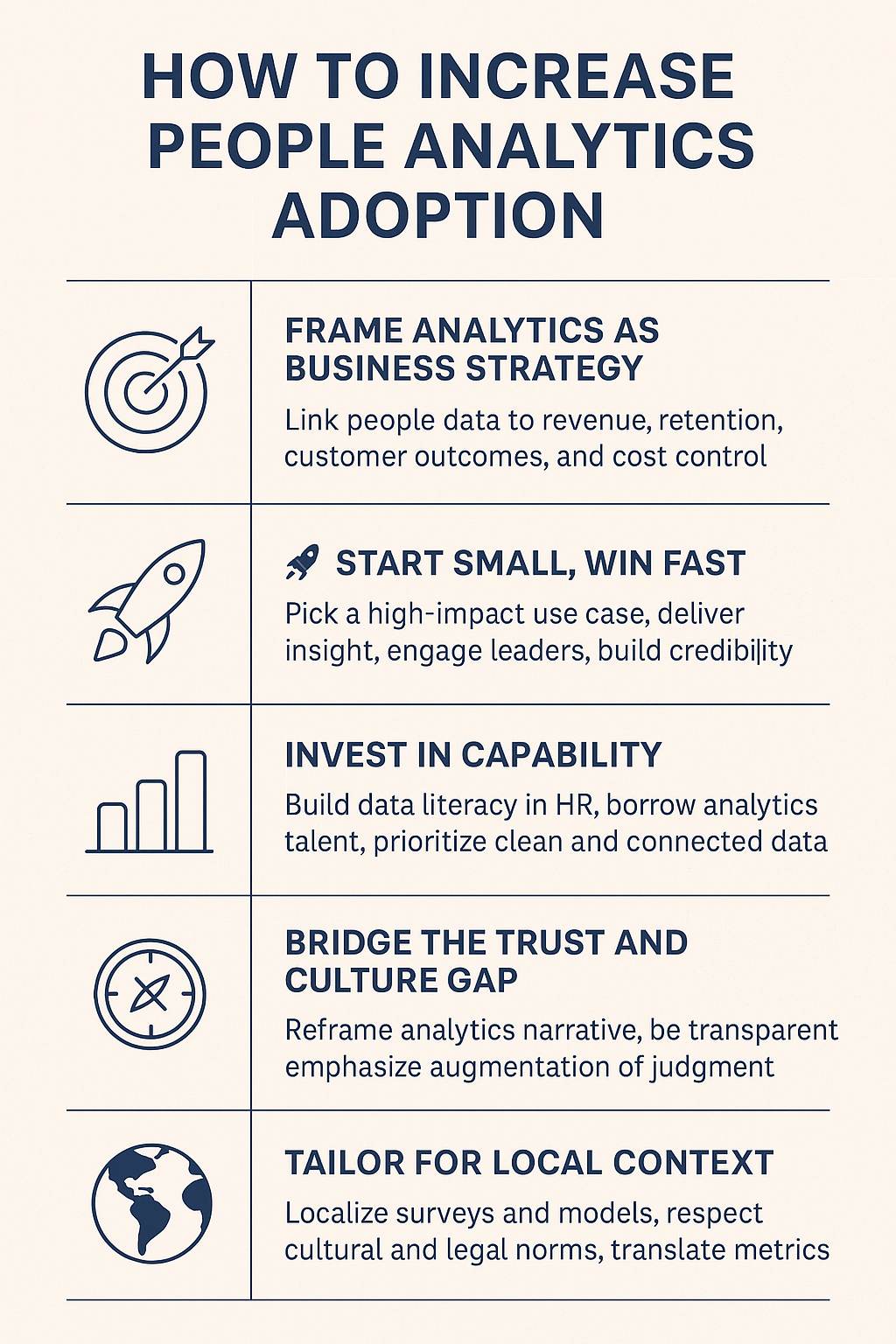
1. 🎯 Frame Analytics as Business Strategy, Not HR Hygiene
If your analytics efforts live only in HR, you’re limiting their power. Great People Analytics links to revenue, retention, customer outcomes, and cost control.
That means speaking the language of CFOs and COOs, not just CHROs.
Show how attrition affects sales. Model the cost of unfilled roles. Demonstrate how your L&D budget reduces time-to-productivity. The goal is not just “better HR decisions”, it’s better business decisions powered by people data.
“In Asia, HR must lead the analytics conversation, not follow IT or finance,” said one Singapore-based CHRO interviewed.
2. 🚀 Start Small, Win Fast
You don’t need a million-dollar HRIS rollout to prove value. Start where pain is obvious.
Pick one high-impact use case:
- Attrition hot spots
- Time-to-hire inefficiencies
- Low performance in a critical function
Deliver insight, engage leaders, and build credibility.
3. 📊 Invest in Capability — Even on a Budget
Most APAC HR teams say they don’t have the tools, talent, or time to do analytics. That’s valid, but solvable.
- If you don’t have a People Analytics team, borrow talent from finance or BI.
- Build data literacy in HRBPs so they can interpret and act on insights.
- Prioritize HRIS maturity: clean, connected data beats fancy dashboards.
If budgets are tight, tools like Excel, Power BI, or Google Data Studio can take you far. The value isn’t in the tech, it’s in the questions you ask and the conversations you enable.
4. 🧭 Bridge the Trust and Culture Gap
Analytics can feel threatening. Some managers fear being judged. Others think data ignores nuance. That’s where HR needs to reframe the narrative.
People Analytics doesn’t replace experience, it augments judgment.
Be transparent about what’s being measured, why, and how it will be used. Emphasize that data is a mirror, not a weapon. When trust goes up, adoption follows.
And yes, address data privacy and ethics upfront: especially in cultures where employee surveillance is a sensitive topic.
5. 🌏 Tailor for Local Context
APAC is not one market. It’s many, and each with unique cultural, legal, and business dynamics.
Don’t copy-paste a global dashboard and expect magic. Instead:
- Localize surveys and analytics models
- Respect data privacy laws
- Translate metrics into local business context
You can also start where data maturity is higher — like Singapore, India, or Australia, and scale from there.
🔁 Time for HR to Lead the Analytics Mindset Shift
The tools exist. The data is there. What’s missing is the leadership will to make People Analytics a core part of how we manage, lead, and grow organizations in Asia.
You don’t need perfection. You need directional insight that drives action.
If we want to influence the business, we can’t wait for the business to invite us in. It’s time for HR in Asia to own the analytics agenda — and change the game.
📩 Want to stay ahead of the curve?
If you found this useful, subscribe to my People Analytics Insider newsletter for:
- Exclusive case studies (like the bias audit we did for a Fortune 500 company)
- Templates (data governance checklist, HR metrics guide)
- Deep dives on turning analytics into action
🚀 Ready to upgrade your people analytics in your firm? Let’s check out the HR metrics you should be tracking