As we step into 2026, HR leaders face a world of work evolving faster than ever. AI, skills disruption, workforce fragmentation, and trust deficits are converging at once, and HR can no longer afford incremental thinking.
Business owners and HR leaders see 2026 as a decisive year. Not because new trends are emerging, but because existing ones are becoming unavoidable. What matters now is not awareness, but execution and credibility. (HR Executive)
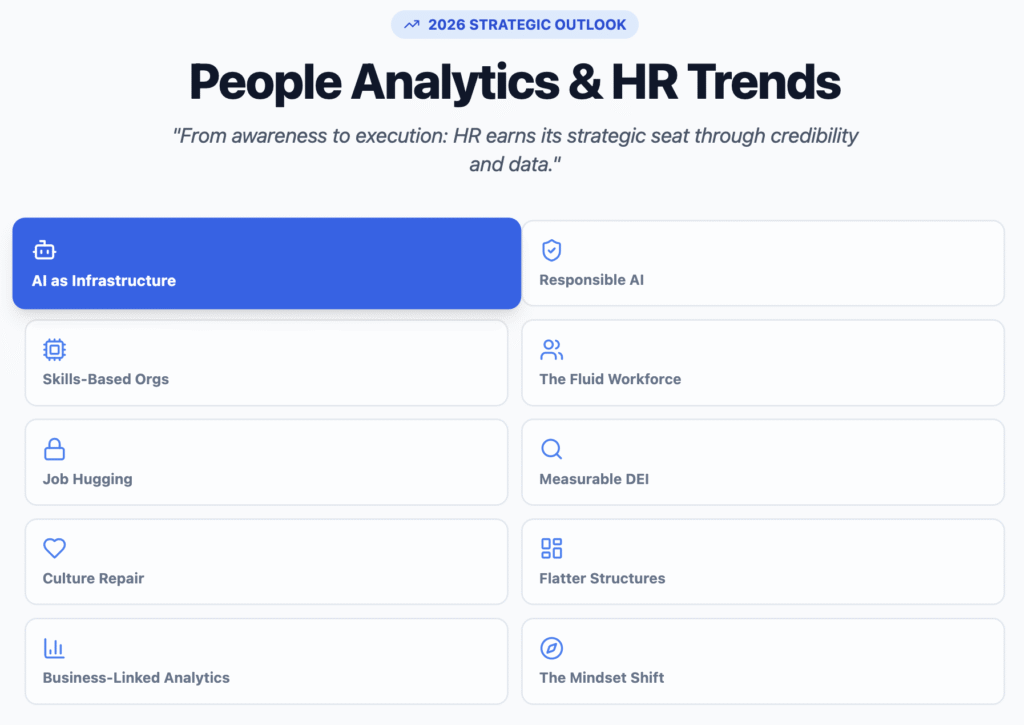
Below are 9 People Analytics and HR trends shaping 2026, grounded in researches and surveying industry leaders, elaborating why they matter, and how we can respond.
1. 🤖 AI Moves From Experimentation to Embedded HR Infrastructure
In 2026, AI is no longer a side initiative. CEOs expect it to deliver ROI, productivity, efficiency, and decision quality, not demos (SHRM). HR teams are embedding AI into workforce planning, talent identification, and managerial decision support. For example, Google’s Gemini AI identified a high-performing yet overlooked engineer for promotion (HR Dive) shows how AI can augment fairness when deployed well.
“Experimenting with AI will not be enough on its own… how effectively HR teams integrate AI into everyday work to improve efficiency will be [what matters],” notes Yahoo’s Chief People Officer Lisa Moore (HR Dive)
2. 🛡️ Responsible AI Becomes a Core HR Capability
With scale comes risk. Bias, misuse, and over-automation have already triggered backlash. In 2026, HR leaders are expected to lead AI governance, not react to it.
Clear usage policies, bias audits, and human oversight are becoming table stakes, especially as generative AI is increasingly used in hiring, performance reviews, and workforce decisions. Trust, not speed, is the limiting factor.
3. 🎓 The Shift from Jobs to Skill-based Org Is Gaining Momentum
A persistent talent crunch is colliding with a wave of automation, making skills, not jobs, the focal point of workforce strategy in 2026. Even amid economic uncertainty and layoffs, critical skill gaps remain.
Skills-based hiring and internal mobility are accelerating (Mclean & Co.), yet only a small fraction of organizations have mature, forward-looking workforce planning. People Analytics is critical here, enabling skills mapping, adjacency analysis, and targeted upskilling.
Organizations that still plan by job titles will struggle. Those that plan by skills will adapt.
4. 🌐 The Fluid Workforce – Gig, Contingent, and Side Hustle Talent Goes Mainstream
The workforce in 2026 is no longer defined by employment contracts alone. Contingent workers, gig talent, fractional leaders, and side hustles are now mainstream. (HR Executive)
Employees are also increasingly pursuing parallel work for skill development or income resilience. Rather than resist this, forward-looking employers are updating policies and analytics to manage risk while retaining trust.
HR must now manage an ecosystem, not a population.
5. 🚀“Job Hugging” and Retention Is Becoming a Leadership Problem
Amid global uncertainty, 75% employees have become risk-averse, clinging to their current roles til 2027 in fear of external volatility, creating “job hugging” behavior (Forbes). It is blocking mobility and frustrating high performers, finding their paths blocked by more senior colleagues staying put.
In 2026, organizations that fail to create visible career pathways will lose talent once conditions improve. Development, internal movement, and honest career conversations are becoming the strongest retention tools.
Career stagnation is no longer a talent issue. It is a leadership issue.
6. 🌍 DEI Shifts From Program to Performance Strategy
DEI efforts are entering a new phase in 2026.
On one hand, there’s intensified skepticism and even political pushback against DEI in some regions (with claims of “reverse discrimination” making legal waves) (HR Dive). On the other hand, evidence is stronger than ever that inclusive, fair workplaces drive business results – and leaders are reframing DEI as essential for performance, not just a moral or compliance effort. As SHRM bluntly states, “Inclusion & Diversity isn’t just a moral imperative — it’s your competitive edge.”
The shift is toward measurable, defensible DEI, using People Analytics to track representation, progression, pay equity, and belonging. Organizations are embedding inclusion into core talent processes rather than running it as a standalone agenda.
The future of DEI is less rhetoric, more evidence.
7. 🤝 Culture Repair Becomes a Strategic Priority
Years of disruption have created what Gartner calls “culture atrophy”, a deterioration of organizational culture that leaves employees disconnected and disengaged. Hybrid work, restructuring, and rapid change have weakened connection and trust.
In 2026, culture is being rebuilt through everyday managerial behaviors: frequent check-ins, real feedback, and visible care. HR is using pulse surveys, sentiment analysis, and network data to monitor culture in real time.
A thriving culture isn’t a “nice-to-have”, it’s central to retaining talent and achieving business goals in the new world of work.
8. 🪜 Flatter Organizations Force New Leadership Models
Delayering continues in 2026, while many Gen Z workers actively avoid people management roles (HR Executive).
Leadership is shifting from hierarchy to influence. AI-enabled tools are helping managers operate at scale, while organizations create alternative career paths for senior individual contributors.
Leadership is no longer about span of control. It is about impact.
9. 📊 People Analytics Becomes Central to Business Decisions
Despite years of investment, only around 10% of organizations meaningfully link people data to business outcomes. (Josh Bersin)
In 2026, that gap is no longer acceptable. AI-driven analytics, real-time dashboards, and predictive models are pulling HR into core strategy discussions.
People Analytics is shifting from reporting to foresight, from HR insight to business intelligence.
Closing: The 2026 Mindset Shift
2026 is not about adopting more tools. It is about earning credibility.
HR leaders who succeed will balance technology with judgment, data with trust, and speed with responsibility. The winners will not be those who chase trends, but those who embed capability, discipline, and ethics into how work is designed.
People Analytics is no longer optional. It is how HR earns its strategic seat.
📩 Want to stay ahead of the curve?
If you found this useful, subscribe to my People Analytics Insider newsletter for:
- Exclusive case studies (like the bias audit we did for a Fortune 500 company)
- Templates (data governance checklist, HR metrics guide)
- Deep dives on turning analytics into action
🚀 Ready to upgrade your people analytics in your firm? Let’s check out the HR metrics you should be tracking