Everyone in HR tech seems to be talking about AI these days (including myself) – from generative AI tools to the latest agentic AI (autonomous AI “agents” that can make decisions and take actions with minimal human input) (Gartner). Venture capital funding is pouring in, vendors are slapping “AI-powered” labels on every product, and expectations are sky-high. But amidst the hype, a provocative question looms:
Is the AI boom in HR technology a bubble destined to burst, or a genuine revolution that just hasn’t delivered results yet?
🚀 The Hype: HR Tech’s AI Gold Rush
It’s not your imagination – we are in an AI frenzy. In Q1 2025 alone, AI startups raised $73.1 billion globally, accounting for 58% of all venture capital funding (Reuters). A startup whose founder is Mira Murati, formerly chief technology officer at OpenAI, even raised $2 billion on a $10B valuation despite having no product or revenue (Computer Weekly). HR tech is riding this wave, touting tools from AI-driven recruiting to autonomous workflows. Yet so far, the results haven’t matched the excitement.
📊 Bubble Worries: ROI Still Missing
A MIT study found that 95% of enterprise AI projects delivered zero measurable return (MIT Sloan Management Review). In HR, 88% of leaders say their AI tools haven’t shown significant business value (Gartner). Employees are eager to use AI, but many don’t know where it fits into their jobs (Gartner). The result? Expensive tools that go unused, and CHROs asking: where’s the ROI?
Financially, most HR AI tools haven’t proved monetization. Many run on investor backing, not business performance. A growing number of leaders are pushing back, demanding tools that do more than just look impressive (Reworked).
💡Turning Point: From Hype to Value
The good news? The AI-in-HR hype is evolving. Companies are shifting from toy projects to practical, ROI-focused AI. At the 2025 HR Tech Conference, vendors pivoted from buzzwords to business outcomes (Reworked).
Some early wins show what’s possible. Companies using AI in talent acquisition saved up to 30% on cost-per-hire (Aptahire). Recruiters slashed sourcing spend by 90% using targeted AI (SHRM). Employees in AI-augmented roles gained back 1.5 hours daily on average (Gartner).
Successful companies are taking a measured, workflow-first approach. They anchor AI projects in clear business problems and focus on integration and adoption.
🎯 Making AI Pay Off: 6 Strategies to Avoid the Bubble
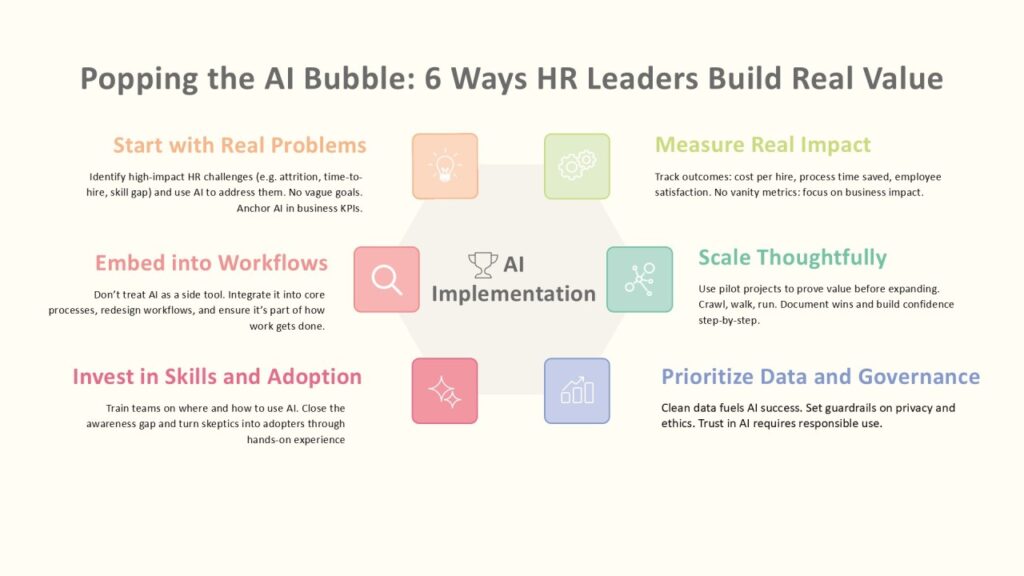
1. Start with Real Problems
Identify high-impact HR challenges (e.g. attrition, time-to-hire) and use AI to address them. No vague goals. Anchor AI in business KPIs.
2. Embed into Workflows
Don’t treat AI as a side tool. Integrate it into core processes, redesign workflows, and ensure it’s part of how work gets done.
3. Invest in Skills and Adoption
Train teams on where and how to use AI. Close the awareness gap and turn skeptics into adopters through hands-on experience
4. Measure Real Impact
Track outcomes: cost per hire, process time saved, employee satisfaction. No vanity metrics – focus on business impact.
5. Scale Thoughtfully
Use pilot projects to prove value before expanding. Crawl, walk, run. Document wins and build confidence step-by-step.
6. Prioritize Data and Governance
Clean data fuels AI success. Set guardrails on privacy and ethics. Trust in AI requires responsible use.
Bonus tip: Partner smart. MIT found firms working with vendors had 2x the success rate in full AI deployment (MIT Sloan Management Review). Customize solutions and hold vendors accountable (MIT Sloan).
⚖️ Final Thought: Reality Check > Bubble Pop
We may be in a hype cycle, but that doesn’t mean AI in HR is doomed. Like the dot-com era, today’s inflated expectations could give rise to tomorrow’s productivity giants, if we focus on outcomes, not optics.
The smart CHROs and people leaders aren’t chasing buzzwords anymore. They’re asking: how does this make my people more effective? If you can answer that clearly, then AI won’t be a bubble. It’ll be your next competitive advantage.
📩 Want to stay ahead of the curve?
If you found this useful, subscribe to my People Analytics Insider newsletter for:
- Exclusive case studies (like the bias audit we did for a Fortune 500 company)
- Templates (data governance checklist, HR metrics guide)
- Deep dives on turning analytics into action
🚀 Ready to upgrade your people analytics in your firm? Let’s check out the HR metrics you should be tracking