The rise of Artificial Intelligence (AI) in HR has sparked a provocative question: will AI supercharge the people analytics function, or will it supplant the humans who run it?
Consider a real example – IBM recently revealed that 94% of typical HR questions are now answered by its AI agent. The same AI-driven approach helps write performance reviews and development plans at IBM. As a result, IBM’s leadership has cut HR headcount and even suggested the HR Business Partner role is nearly obsolete aside from senior advisors. IBM claimed that their AI can predict which employees will quit with 95% accuracy – saving $300 million in retention costs – and that these tools led to a 30% reduction in IBM’s global HR staff.
Those are bold statements. But are they a sign of things to come for people analytics, or a cautionary outlier? Below we’ll explore how AI is transforming people analytics, what it can and can’t do, and whether human expertise in HR analytics is truly at risk – or more crucial than ever.
🚀 How AI Is Supercharging People Analytics
There’s no doubt that AI is rapidly augmenting HR analytics capabilities. In fact, 42% of large companies (5,000+ employees) were using some form of AI for HR tasks by early 2022, and about two-thirds of CHROs expect AI to positively impact HR within two years. Some key capabilities where AI supercharges people analytics include:
1. Data Crunching at Scale:
-
AI can rapidly analyze large, disparate HR datasets to find patterns and correlations that humans might miss.
-
For example, predictive algorithms can pinpoint flight-risk employees with accuracy. Instead of analysts spending weeks munging data, an AI can sift through attrition rates, engagement scores, manager feedback, and more in seconds to flag who might leave next.
2. Generating Insights & Reports:
-
Modern people analytics platforms now embed generative AI that can answer natural-language questions and produce narrative reports.
-
Tools like Visier’s “Vee” or Workday’s “Illuminate” let HR leaders “talk with their data” – you can ask “Which factors drive sales performance?” and get an instant analysis.
-
AI can even draft plain-English summaries and visualizations of workforce trends, freeing analysts from manual reporting.
3. Automating Repetitive Tasks:
-
Data cleaning, scheduling, and basic reporting can be handled by intelligent bots.
-
HR leaders report using AI to improve data accuracy, generate real-time reports, and even perform sentiment analysis on employee feedback – tasks that used to require endless human hours.
4. Predictive & Prescriptive Analytics:
-
Machine learning models can forecast outcomes like who is likely to resign, which candidates will succeed, or what skills gaps are emerging, with a level of complexity and scale that a human alone could not match.
-
AI’s predictive power can help HR anticipate workforce needs and outcomes rather than just analyze history.
It’s clear that AI can turbocharge the efficiency and scope of people analytics. That leads us to the crux of the debate: if AI handles so much, do we still need the people in people analytics?
🤖 Will AI remove the ‘People’ from People Analytics?
It’s a valid concern. We’ve already seen AI eliminate certain HR roles. Some traditional HR and analytics jobs will disappear or radically change.
However, I would argue that AI’s rise makes human expertise more important, not less. Instead of replacing analysts, AI can act as a “force multiplier” for them.
Just as Thomas Malone of MIT’s Center for Collective Intelligence has observed that “combinations of humans and AI work best when each does what they do best”.
Let’s break down a few reasons why the human element remains irreplaceable in people analytics:
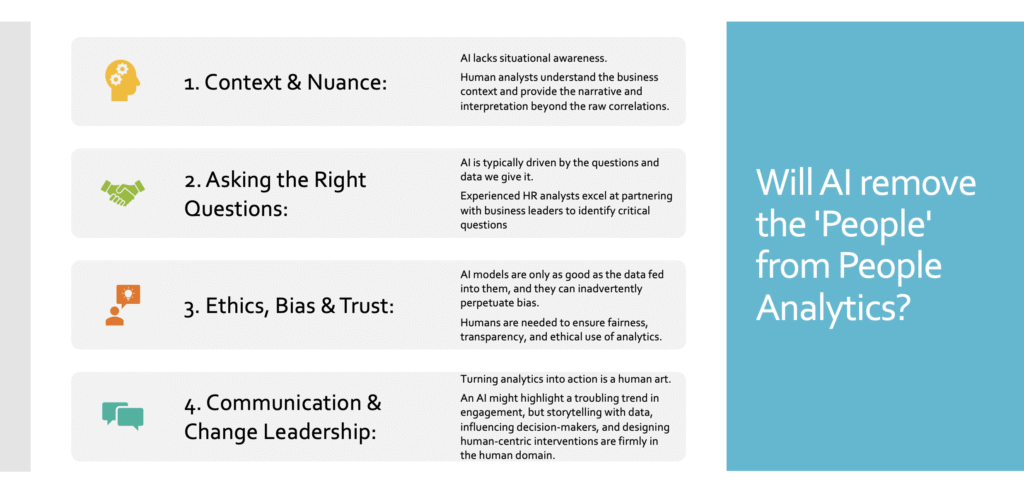
1. Context & Nuance:
- AI can crunch numbers, but it lacks situational awareness.
- Human analysts understand the business context behind the data like strategy changes, team dynamics, or market conditions that algorithms don’t inherently “know.” Human experts provide the narrative and interpretation beyond the raw correlations.
2. Asking the Right Questions:
- People analytics isn’t just about getting answers. It’s about figuring out what to ask in the first place.
- AI is typically driven by the questions and data we give it. Experienced HR analysts excel at partnering with business leaders to identify critical questions (e.g. “How does culture affect retention of top engineers?”).
3. Ethics, Bias & Trust:
- AI models are only as good as the data fed into them, and they can inadvertently perpetuate bias.
- Humans are needed to ensure fairness, transparency, and ethical use of analytics. Building trust in AI insights requires a human touch: explaining AI results in clear terms and validating them with intuition and experience.
4. Communication & Change Leadership:
- Turning analytics into action is a human art.
- An AI might highlight a troubling trend in engagement, but storytelling with data, influencing decision-makers, and designing human-centric interventions are firmly in the human domain.
💼 Evolving People Analytics Career in the Age of AI
Rather than fearing replacement, many HR analytics experts suggest embracing AI as a career catalyst. In my view, the analysts who thrive will be those who pair their domain expertise with AI, essentially becoming “bionic” analysts who leverage technology for maximum impact:
1. From Data Janitor to Data Strategist:
- AI’s automation in data gathering, cleaning, and preparation will shifts the human role toward managing the data pipeline and ensuring data quality, selecting the right datasets to feed the AI.
- The analyst becomes more of a data strategist – curating the inputs and then letting the AI do the heavy analytical lifting.
2. Evolve Our Role:
- AI is democratizing analytics, enabling non-technical HR professionals to do more analysis themselves.
- People analytics experts can take on an educator and consultant role, training HR colleagues to use AI tools effectively and responsibly.
3. Focus on High-Value Problems:
- With AI handling many routine queries (“Which office has the highest turnover?” ), human analysts can zero in on complex, high-value projects, which often require blending data with qualitative insight, running thought experiments, and collaborating with leadership, tasks where human creativity and business acumen shine.
4. Stewardship of AI Ethics & Outcomes:
- As AI becomes embedded in people decisions (hiring, promotions, evaluations), people analytics teams may act as the guardians of AI ethics and effectiveness.
- They will monitor algorithms for bias, validate predictions against real outcomes, and ensure that using AI doesn’t inadvertently harm employee trust or diversity.
📩 Want to stay ahead of the curve?
If you found this useful, subscribe to my People Analytics Insider newsletter for:
- Exclusive case studies (like the bias audit we did for a Fortune 500 company)
- Templates (data governance checklist, HR metrics guide)
- Deep dives on turning analytics into action
🚀 Ready to upgrade your people analytics in your firm? Let’s check out the HR metrics you should be tracking