📌 Why Measure Productivity in Knowledge-Based Work
Productivity has always been the critical part of business performance, but in today’s knowledge-driven economy, measuring it is more than just an efficiency metric. It’s a strategic imperative.
As a People Analytics leader, I’ve seen the shift first-hand. Companies are no longer satisfied with tracking just outputs. They want to know:
Are we working on the right things? Are we enabling flow, focus, and creativity? Are hybrid ways of working helping or hindering performance?
At its core, measuring productivity helps organizations:
- Align efforts with business outcomes 📈
- Inform workforce planning and organizational design
- Identify bottlenecks in systems and workflows
- Enable smarter decisions on return-to-office or hybrid policies
Yet, despite all this, most companies struggle to measure productivity in a way that’s both accurate and fair.
🧠 Why Measuring Knowledge-Worker Productivity Is Hard
In manufacturing, productivity is tangible: output per unit of time. But knowledge work isn’t about widgets or lines of code — it’s about problem-solving, decision-making, communication, and creativity.
Knowledge work refers to roles where the primary output is intellectual effort rather than physical labor. These include analysts, developers, designers, product managers, HR professionals, strategists, and more. What they produce isn’t always easily counted — you can’t quantify a breakthrough idea or an insightful hiring decision the same way you count factory output.
This makes measurement inherently complex:
- Outputs are intangible
- Work is often non-linear and collaborative
- Success depends on context, not just activity
We fall into the trap of using proxies — like hours worked, emails sent, or meetings attended — none of which truly capture value. These metrics can easily become vanity metrics that measure activity, not impact.
And let’s be honest: many knowledge workers (myself included!) feel uneasy when “productivity” starts to sound like surveillance. That’s why metrics must be:
- ✅ Transparent
- ✅ Purpose-driven
- ✅ Connected to business outcomes, not just motion
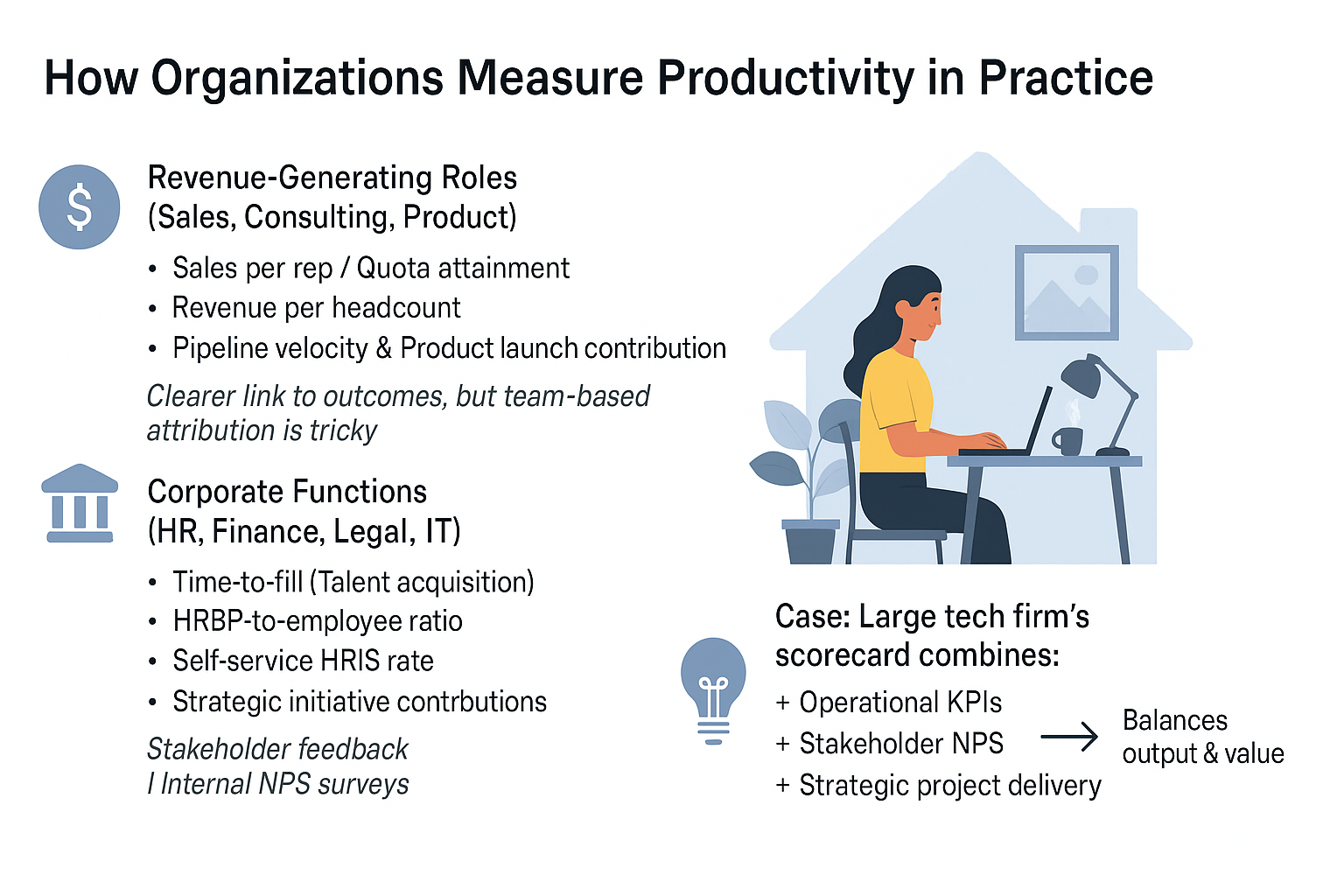
📊 How Organizations Measure Productivity in Practice
Despite the challenges, companies are getting creative. Let’s break it down:
Revenue-generating roles (Sales, Consulting, Product):
- Sales per rep / quota attainment
- Revenue per headcount
- Pipeline velocity
- Billable utilization rate (Consultant)
- Contribution to product launch cycles
These roles offer clearer links between effort and outcomes — but even then, attribution can be tricky when success is team-based.
Corporate functions (HR, Finance, Legal, IT):
Here’s where it gets fuzzier.
Smart organizations align metrics with service quality, turnaround time, and strategic enablement. For example:
- Transactions or reports processed per Finance employees
- Average cycle time to close a legal matter
- Time-to-fill for talent acquisition ✅
- Ratio of HR business partners to employees
- Self-service rate for HRIS tasks
- Contribution to strategic initiatives (e.g. HR’s role in M&A)
Sometimes, productivity is measured through stakeholder feedback or internal “customer satisfaction” surveys.
💡 One large tech firm built a scorecard for enabling functions combining:
- Operational KPIs (e.g. cycle time, compliance)
- Stakeholder NPS
- Strategic project delivery
This multidimensional approach helps balance output with value.
🏡 Hybrid/Remote vs. In-Office Productivity: Lessons from Trip.com
No productivity discussion is complete without tackling hybrid work.
Nic Bloom led a 2-year study with Trip.com, running 6-month randomized trial involving 1,600 employees. Half worked remotely 2 days/week. The results?
- Productivity stayed flat overall and no drop in output
- Attrition dropped by 33% among hybrid workers
- Job satisfaction and work-life balance increased
This matters. The study shows that hybrid work, when structured thoughtfully, doesn’t harm performance, and may boost engagement and retention. That’s a productivity gain in disguise.
For leaders, the takeaway is: measure outcomes, not attendance. Trust your people, and back it up with data.
🧩 Frameworks and Principles for Measuring Productivity
Want to start measuring productivity meaningfully? Here are key principles:
1. Start with the work, not the worker
Understand the business process first. What’s being produced? What drives outcomes? Productivity is contextual.
2. Focus on outcomes, not activity
Don’t count keystrokes. Instead, measure deliverables, cycle time, quality, and business impact.
3. Co-design with teams
Involve managers and employees in defining what productivity looks like. This builds trust and relevance.
4. Use directional, not perfect, data
You don’t need a “productivity score” to get started. Use surveys, interviews, or lightweight metrics. Directional insight > analysis paralysis.
5. Combine quantitative + qualitative
Pair metrics with feedback and narrative. Data alone can’t capture nuance.
6. Use People Analytics as a bridge
As People Analytics practitioners, we can connect work data (e.g. systems usage, time allocation) with business metrics (revenue, NPS, retention) — and wrap it with a compelling story.
🎯 Final Thoughts
Measuring productivity in knowledge work is hard, but it’s not impossible. It just requires a shift in mindset.
Instead of hunting for the perfect metric, focus on meaningful conversations. Use data to provoke insight, not surveillance. And remember: productivity isn’t about doing more. It’s about doing what matters.
📩 Want to stay ahead of the curve?
If you found this useful, subscribe to my People Analytics Insider newsletter for:
- Exclusive case studies (like the bias audit we did for a Fortune 500 company)
- Templates (data governance checklist, HR metrics guide)
- Deep dives on turning analytics into action
🚀 Ready to upgrade your people analytics in your firm? Let’s check out the HR metrics you should be tracking