Over years I’ve been seeing more HR leaders bring up Robotic Process Automation (RPA) — in strategy meetings, during vendor demos, and sometimes just as a “should we look into this?” kind of question.
I get why.
HR teams are under pressure — reduce admin, do more with less, respond faster, and be more “data-driven” while also being more human. RPA, on the surface, sounds like the fix. But where does it actually stand today in our space?
Let’s break down what RPA is, why it matters in HR, and how the most forward-thinking companies are already using it to gain speed, accuracy, and a competitive edge.
💡 What is RPA — and Why It Matters for HR
Robotic Process Automation (RPA) is a type of software that uses “bots” to mimic human actions — like logging into systems, copying data, sending emails, or generating documents. Think of it as your ultra-fast, never-tired digital assistant.
📈 The global RPA market is booming — projected to grow from $18 billion in 2024 to over $72 billion by 2032 (Fortune Business insights). But here’s where it gets interesting for HR:
- Only 8% of HR organizations have fully scaled RPA, with another 17% running pilots. (Medium)
- Yet 45% of HR leaders plan to invest in hyper-automation or RPA soon. (AIMultiple Research)
What does this mean?
- 🟢 The demand is real.
- 🔴 The adoption gap is wide.
- ⚡ The opportunity is NOW.
Whether you’re looking to reduce manual workloads, improve compliance, or speed up onboarding, RPA gives HR teams the power to do more — with less.
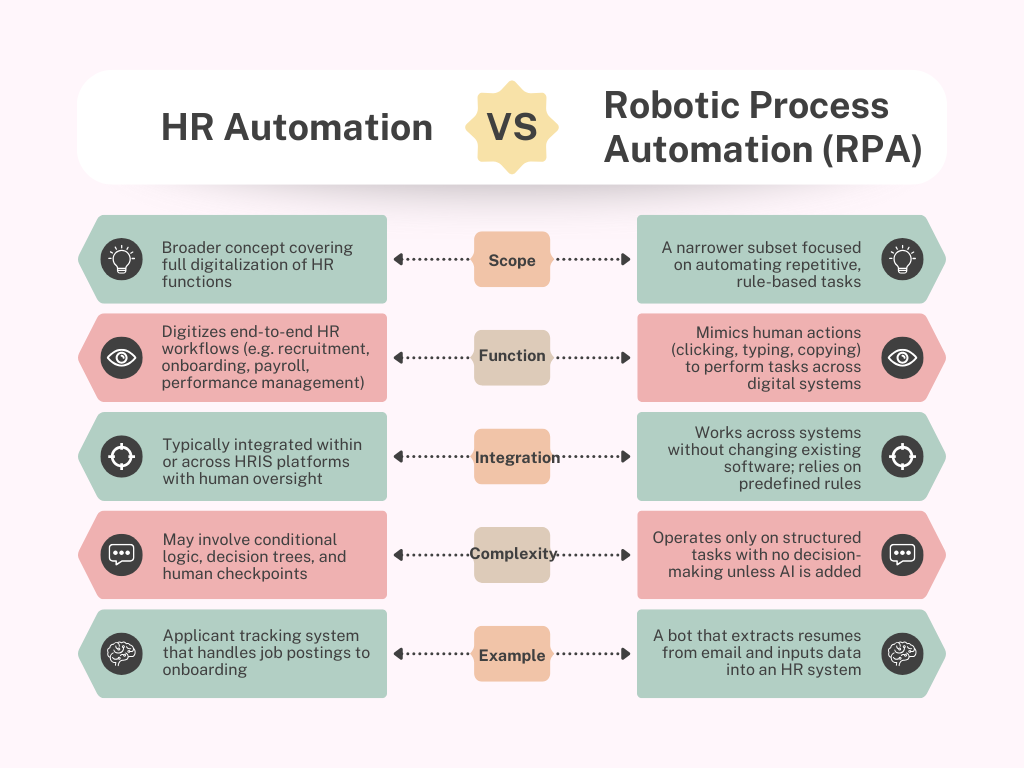
🔍 HR Automation vs RPA — What’s the Difference?
RPA is not intelligent by default — it’s not AI. It doesn’t reason or decide. But it is fast, scalable, and remarkably useful when applied to well-structured tasks.
RPA and HR automation are sometimes used interchangeably, but they are not the same.
🧠 Where It Actually Works: Real Use Cases from the Field
If you’re still wondering whether RPA delivers real value in HR, here are 3 case studies that show what’s possible:
🏢 Dell — Automating Admin at Scale
Dell faced a familiar challenge: too many manual HR tasks slowing down operations. From assigning recruiters to new job requisitions, to updating HR reports and databases — the administrative overhead was significant.
By deploying RPA across 30+ HR processes, Dell drastically reduced this burden. The bots took over routine tasks such as updating applicant statuses, moving data across systems, and sending reminder communications.
Impact:
- ✅ Productivity increased by up to 85% in automated areas
- ✅ Administrative processing time shrank dramatically
- ✅ HR staff could refocus on talent strategy, not transactions
This example illustrates how RPA can scale across complex, high-volume environments with measurable impact.
🧾 Coca-Cola — Strengthening HR Compliance
Coca-Cola’s HR team was manually auditing data across SAP systems, but could only manage a sample of records due to time constraints. That limited their visibility into compliance risks.
With RPA bots deployed to handle audit checks, data validations, and reporting, Coca-Cola automated over 50 audit-related processes.
Impact:
- ✅ Gained an extra 16 hours of audit productivity per day (bots work after hours)
- ✅ Achieved 100% audit coverage, rather than small samples
- ✅ Significantly improved compliance confidence and reduced risk
This is a classic case where RPA supports governance, not just efficiency — a major plus for organizations in regulated sectors.
📊 IBM — Streamlining the Promotion Process
IBM’s HR operations team manages a vast volume of promotion cycles — around 15,000 employee cases in one cycle. Traditionally, this involved manual collection and verification of performance data, tenure records, and compensation eligibility.
RPA was introduced to handle data aggregation and validation across multiple systems.
Impact:
- ✅ Saved 12,000 hours in a single quarter
- ✅ Reduced process time from 10 weeks to just 5
- ✅ Increased accuracy and transparency in promotion decisions
In this case, RPA didn’t just save time — it also helped HR deliver a better employee experience with faster, fairer decisions.
These examples prove that RPA isn’t theoretical. It’s already transforming HR operations at scale — when used for the right tasks.
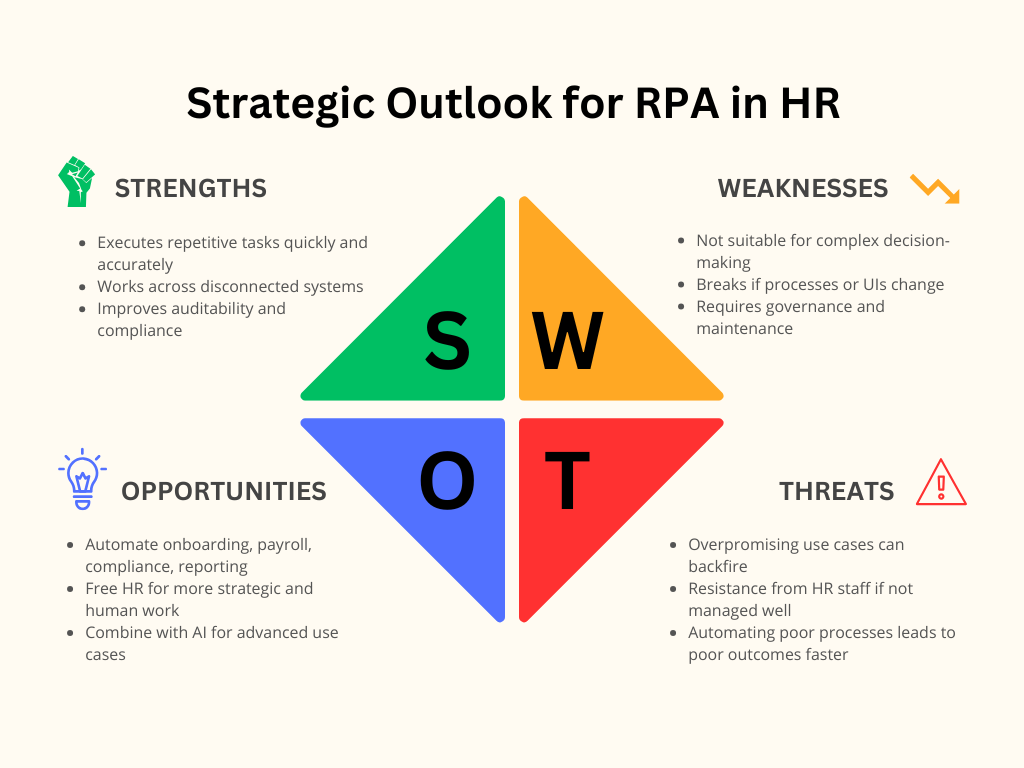
📊 SWOT View: Strategic Outlook for RPA in HR
🔧 What I’d Recommend If You’re Exploring RPA
If I were advising a team today (which I often do), here’s what I’d say:
- Start with one real pain point.
Not “what’s trendy” — but what wastes your team’s time. - Fix the process before you automate it.
RPA doesn’t solve complexity; it magnifies it. - Keep people in the loop.
Train them, get their input, let them co-own the solution. - Track ROI and learning.
This isn’t just about time saved. It’s about creating space for better work.
📩 Want to stay ahead of the curve?
If you found this useful, subscribe to my People Analytics Insider newsletter for:
- Exclusive case studies (like the bias audit we did for a Fortune 500 company)
- Templates (data governance checklist, HR metrics guide)
- Deep dives on turning analytics into action
🚀 Ready to upgrade your people analytics in your firm? Let’s check out the HR metrics you should be tracking